
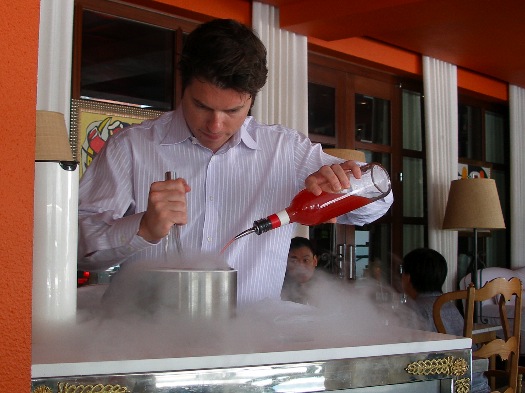
Many people in the restaurant industry would be satisfied with a prized post at El Bulli, but not Barcelona native Lucas Paya, who has always been inspired by new challenges. Paya worked as an El Bulli sommelier from 2002 to 2007. During that time, Ferran Adria’s close friend José Andrés would frequent the restaurant, and Paya got to know Spain’s second most famous chef. Paya left Spain to work as a Spanish wine importer in Manhattan. He traveled to D.C. on a business trip and reconnected with some former El Bulli colleagues who were working at Andrés restaurants like Jaleo and Minibar. Over a plate of jamon at Jaleo, Andrés mentioned his plans for SLS, a new hotel brand he was helping to launch in Beverly Hills. Paya was inspired to become SLS Hotel Beverly Hills’ beverage director. On May 20, Paya sat down in the depths of SLS to discuss his background and approach with wine and cocktails.
What was it about the opportunity with SLS that interested you?
A lot of things. This new position as a beverage director for the hotel. Starting from scratch from day one. When I joined the company, there was nothing here. We started from the very, very bottom and built that up. That was very, very challenging and very interesting at the same time because that was something I hadn’t done before to that degree, and I’ve been working with beverages almost all my professional life.
What was your hope to be able to accomplish in this location?
Survival. Make something happen somehow. Be successful somehow. To have a new personal experience. New experiences and stories to tell when you’re older, all these things that happened to you when you were away from your family. To me, that’s already a success. If you get by in an environment that is foreign or not something you’re used to, it’s an accomplishment. We thought we could do something here at SLS that would get some recognition. People talk about it and come back and enjoy. That says a lot…I’m very happy.
What was your approach with the beverage program, and how close did you work with José in building the program?
He’s got great expertise. So much of what you see, he’s been working for a goal, working to get something, since the ’80s. 15 years ago, he started in restaurants in the D.C. area trying to show people a culture that was completely new at the time, the Spanish culture. So he’s got a lot of experience and expertise in putting something together that will have an impact. It’s going to create this feeling in the people the first time they come to a lot of his restaurants and it’s completely different. It was just a matter of following his recommendations and having my personal experience and involvement. Working with him on this project at SLS, in the fact that we coordinated and agreed in most of the steps, it was like working with a person that had the same way to think. It was pretty exciting and pretty important for my career to build this. It was something that could be different from the beginning. If I thought about it, and I did, my idea would be quite different from what it was at the end of the day. But at the same time I need to say it was easier than expected because his background being Spanish, we really connected when trying to define what we wanted to do here.
In what way is his beverage program different here than at his restaurants in D.C.?
SLS combines a little bit of all the restaurants we have in the D.C. area. You can find traces here that come from Zaytinya, Oyamel, from Jaleo, even from Café Atlantico. If you want to know José Andrés and all his work throughout the years, you just need to come to SLS. We have a little part of all his features, all his very best and interesting items. Cocktails, dishes, presentations and techniques. SLS is a good showroom whoever wants to know José’s work in the last 15 years.
What are the different outlets and how are they different?
We have one single wide open space, but as you know, we have different sections. Different sections have different themes, so the wines are of course different. We have the Patisserie, starting from the right hand side, which is the end of the meal where you can enjoy after-dinner and desserts. That list has the most dessert wines and the longest list of after-dinner spirits. Then Bar Centro is more the jumping off point. It’s the first thing you see when you walk into The Bazaar, so we have a long list of champagnes, crisp wines and sakes. It’s more an aperitif outlet, the place where you’re going to start your meal. At Rojo Y Blanca, we consider them two different venues despite the fact that you’re going to be presented the same food regardless of where you’re sitting. The original concept for those two different wine sections was different. I had one wine section for Blanca and one wine section for Rojo, plus the one I’m putting together is for Ssam. That will be five. That’s only in The Bazaar, five different wine presentations.
How are the wine lists for Rojo, Blanca and Ssam different?
Rojo is 100% Spanish, so the wines there are all Spanish, arranged by style and then region. I have Rose, Sherrys, and of course Cavas, whites and reds, all from Spain. At Blanca, I have Global Selections, everything that’s not Spanish, wines from California and other parts of the world. They are arranged by grape variety, which is to my understanding, a more modern way to arrange wines. I have 45 wines there. It’s a more global, modern section of the wine list, trying to tie in with the décor and the food offerings. Depending on where you’re sitting, you’ll get the same food variety, but you’ll see one section that says Traditional Tapas. That would be more Rojo side, Spanish wines. The other side, you have a menu that says Modern Tapas, the more Blanca side.
What’s your approach with Ssam’s wine list?
I’m going to have a more expensive, high-end wine list selection. I’m working on that these days, but I’m thinking of presenting these wines under three categories. It’s going to be really fun, something different. We’re going to have three arrangements. I’m thinking of having one that is all under vintage, another one that is all under appellation, and another one that is all under grape varietal.
When do you plan to introduce that?
In a couple of weeks, probably. I still have to get some wines to complete two or three sections of the wine list in the way that I want.
How often does your wine list change, and what does it depend upon?
I try to drink wines every week. It’s a quarterly wine list, so every three months we change 25 or 30% of the wine list.
Would you say that you have a wine mentor?
Yeah. My old colleagues from Spain showed me the wine business and worked with me, especially a couple of friends. I don’t have one single person that I used as a mentor. I see myself reflected in those people. It’s been fun and it’s been great to work with my friends in the industry.
Anybody in particular, and what did they teach you?
Most recently, Juli Soler, the owner of El Bulli. That was a great experience, working with him. The way that he sees the wine, the respect he has for wine, that was truly an epiphany. He expanded my knowledge and the way that I see wine.
How did you become so interested in wine?
It was a logical evolution of my career. I started working at restaurants and then I started to cook. From the kitchen, I went on to the floor and specialized in service. Doing service, there was something there that, to me, I understand. The table, the silverware, the China, the tablecloth, all the techniques that you can do to prepare dishes tableside. All the experiences you can have talking to the guests at the table. In all these things you can have service, but the thing that I thought it was most outstanding or interesting was the wine. It was an ingredient, the first part of the experience. It was the most interesting but least known by anybody I knew. My father was a wine drinker and he taught me the first steps of enjoying and appreciating wine. It was something that when you were young, and in my case, I look to my father and thought that anything he was saying was important. He was interested in wine and gave me this push.
What’s your earliest wine memory?
That would probably be with my father. My first step was hearing about wine. I cannot tell you a bottle in particular, but I can remember on many occasions, talking about wine at the table with my father and thinking, What is he talking about? What is this guy saying, talking about the grape variety, producer or region?
How old were you?
15, 16 years old.
What are some of the resources you use to stay current as far as wine and cocktails go?


Leave a Comment